THE BREAKDOWN: Can Ralph Priso crack the CanMNT World Cup squad as a centre back after position switch?



Just months out from the 2026 World Cup, Ralph Priso has earned a long-awaited call-up to the CanMNT, as he was included in their squad for the upcoming March window.
After bursting onto the scene with Toronto FC as a promising 18-year-old midfielder in 2020, this has been a long time coming for Priso, who now turns 24 later this year.
He’s been involved in the Canadian set-up before, as he played for Canada at the U15 and U17 level, and has been part of multiple ‘Camp Poutine’ environments, but this is his first inclusion in a full-blown senior camp.
Having dealt with injuries, inconsistency and multiple trades across the last few years, he’s not been able to turn the glimpses of promise that he showed as a youngster into more, unfortunately.
Until now, that is. Now with the Vancouver Whitecaps, Priso has blossomed into a whole new player over the last year, playing a big role in the club's recent success.
As a result, it has opened the door for him to earn this CanMNT call-up, a culmination of years of hard work.
While Priso will have envisioned one day earning this call-up, though, even he wouldn’t have imagined in his wildest dreams that his first official senior cap could come later this month as a… centre back.
Yet, that’s been the most remarkable part of Priso’s story, as he’s been playing some of his best soccer at a brand-new position, one he had never played up until six months ago. 
Only tasked to play there in an emergency for a late-September matchup against the Seattle Sounders in MLS action last fall, as the Whitecaps faced a crisis of centre back injuries and absences, Priso immediately looked at home at his new position, and he hasn’t looked back since.
Despite being what most would consider to be quite short for a centre back, standing at just 5’9”, Priso immediately showed good instincts in his new role. To make up for his height, he tried to play aggressively without the ball, which fit perfectly with what the Whitecaps aim to do, which is to suffocate teams as high up the pitch as possible with their press and high defensive line. 
Here's a clip from a recent Whitecaps match, their loss to the Seattle Sounders in Concacaf Champions Cup action. On this play, look at how Priso uses his speed to recover a ball, before making a nice progressive pass forward (OneSoccer)
Thanks to his speed, Priso was willing and able to fulfill those demands, knowing that he could erase any mistakes with his legs, which allowed him to play a bit more aggressively than others in his position might have.
It was just a January Camp friendly vs. 🇬🇹, but it's hard not to get excited about defensive plays like this from Ralph Priso. Great speed and awareness
— Alexandre Gangué-Ruzic (@AlexGangueRuzic) January 20, 2026
Safe to say he put in a credible 1st audition for the #CanMNT as he begins his push for a World Cup roster spot#VWFC https://t.co/rKJpqimWEy pic.twitter.com/JhcTCffJje
Then, of course, there was what Priso brought on the ball, which may have been the biggest benefit of him slotting in as a centre back. Already solid in possession as a midfielder, he was even better on the ball as a centre back, as he benefited from the extra time and space on the ball that the position can provide to players.
For a Whitecaps team that tries to wear down opponents in possession, he’s offered them new flexibility on the ball with his ability to play with pace and intensity. In particular, he’s done a great job of breaking lines with his passing and pressing structures with his dribbling, allowing the Whitecaps to take more risks when building out of the back. 
Here's Priso using his dribbling and confidence on the ball to break the Sounders press, helping create a dangerous Whitecaps attack (OneSoccer)
In a sense, though, the easiest way to explain Priso’s success as a centre back is this - while he might not have profiled as a traditional central defender, he embodies the evolution of the position, one that is constantly changing in the modern game.
The Whitecaps know that better than anyone. Just look at the success of Priso’s frequent defensive partner, Tristan Blackmon, who was named MLS’s Defender of the Year in 2025.
Before arriving in Vancouver, Blackmon had often played as a full back with old club LAFC, but has since turned into an excellent centre back, especially after the arrival of head coach Jesper Sørensen, who was the one to employ this aggressive system. All of a sudden, Sørensen’s arrival placed a demand on players who were comfortable with defending aggressively high up the field, had a strong understanding of how to defend space, and were good on the ball, such as Blackmon and Priso.
Of course, credit has to be given to Priso for adapting to the position the way he is, as that has completely altered his career trajectory, helping him accelerate his evolution as a player.
“Ralph is a unique example of a player who has shown a willingness to take on completely new challenges,” Sørensen said this week. “But also a guy clever enough to see that it might be beneficial for him to do so for the future.”
Changing positions places a lot of mental strain on a player, but Priso hasn’t minded that whatsoever, which is also a credit to his approach to the game.
“The way we play, I think it suits me well, to the point where I can almost play with my mind, I would say, sometimes more than even my physical abilities,” Priso explained last fall. “So it's just about understanding what my role is, wherever it is, and understanding what I need to do to help the team.”
Here's Priso using his passing range to once again break the Sounders press, helping create an attacking opportunity for the Whitecaps (OneSoccer)
To that point, though, it’s fascinating to see the numbers behind the shift. Now, having played over 1400 minutes as a centre back, it helps give a better idea of how he’s adapted over the last six months.
Firstly, there’s the work he’s done on the ball, which naturally stands out when diving into those 1400 minutes worth of data.
As expected, he’s been quite secure in possession, averaging 60.53 passes per 90 minutes (at a 92.9% clip), but he’s also done a good job of progressing the ball, attempting 3.21 long balls per 90 (at a 50% clip) and 6.87 passes into the final third per 90 (at a 86.9% clip).
Yet, the big reason for that is because he’s attempting 19.96 forward passes per 90 (at a 86.5% clip) - meaning almost one-third of his passes are played forward (and for context, he’s sending just 3.27 passes backwards per 90, so most of his passes are going forward or sideways). 
Here's Priso's pass map from the 2026 MLS season. As seen here, he's got a decent number of progressive passes, especially in the middle third of the pitch (American Soccer Analysis)
By comparison, when he played in midfield in 2025, he averaged 46.19 passes per 90 (at a 90.1% clip) with 2.48 of those passes going long (at a 49.1% clip), and 7.15 of those passes going into the final third (at a 79.1% clip) - all solid numbers. The big difference, though, came with his forward passes, as he averaged just 11.55 forward passes (at a 79.4% clip) and 7.43 backwards passes (at a 98.1% clip).
That’s not a bad thing, as part of the job description of a midfielder is to be secure in possession, and to do that, you have to pass backwards sometimes. Plus, as a centre back, it can be easier to play forward passes than backward ones, so that’s also worth noting that Priso’s forward pass numbers aren’t out of the ordinary.
If anything, the most interesting stat is that despite playing deeper on the pitch, Priso’s averaging just as many passes into the final third as he was in midfield, showing how much more aggressive he’s been on the ball despite playing in a deeper position. He’s helped by the fact that he’s seeing more of the ball at centre back, no doubt, but that ability to actually progress the ball from deep has helped give the Whitecaps another option in terms of their build-up play.
Here's an example of the sort of line-splitting passes Priso can play - even if it didn't work out on this play (OneSoccer)
In theory, it would’ve been very easy for him to see a drop in his passes to the final third as a centre back, which would’ve meant that he was just playing simple passes into his midfielders to let them progress the ball, but instead, he’s pushing the ball into dangerous areas as often as possible.
Of course, what he does on the ball is half of the equation as a centre back. For as good as he’s been on the ball, it wouldn’t matter if he was struggling to defend.
As the numbers show, though, he’s done pretty well in that department. In his minutes as a centre back, Priso is averaging 3.98 interceptions and 10.14 recoveries - the last figure, in particular, is quite solid as it highlights his ability to scuff out dangerous balls in behind the Whitecaps backline.
Then, in terms of his duels, he’s also been pretty good - he’s winning 61.6% of his 8.86 total duels, including 68.2% of his 4.24 defensive duels, and, surprisingly, 51.6% of his 1.99 aerial duels. Naturally, with how much the Whitecaps spend on the ball, his volume of duels isn’t that high (no need to get stuck into as many 50/50 challenges if you always have possession), but that’s why the win rate stands out.
Plus, that’s why his interception and recovery figures were extra important, as those numbers indicate Priso’s ability to aggressively step up the field and protect space behind his defensive line.
For context, in midfield last year, he averaged 3.83 interceptions and 8.98 recoveries per 90 minutes - the latter figure isn’t surprising, but the former is, as typically one would’ve expected Priso to be racking up more interceptions in midfield. Otherwise, Priso averaged more total duels and defensive duels (which makes sense as a midfielder gets stuck into more 50/50 plays), although he won just 52.3% of his total duels and 58.2% of his defensive duels, which were solid numbers, but not as good as what he’s averaged at centre back.
Plus, it must be remembered that Priso was quite functional as a midfielder last year. He played almost 2000 minutes at the position last year, doing well enough to even be on the fringes of the CanMNT set-up with how he was playing, so that’s worth noting.
What those numbers on both sides of the ball show, though, is that he’s hit a whole new level as a centre back, which is why this position change has been so exciting to see for him.
Unfortunately, with how early it is in the MLS season, there’s not enough data out there to fully compare Priso to his peers quite yet, which would be quite fascinating to do, as his 2026 numbers are even better than the ones above, which also include the minutes he played at the position last fall.
Of course, it isn’t always easy to compare centre-backs with each other, as it might be the position where statistics are most affected by the team around them (especially in terms of defensive numbers), but it could’ve helped give an idea of how good he’s been on the ball, for example.
What can be done, though, is to compare those numbers to another player - and in that regard, why not use Priso’s teammate, Blackmon, given his status as the 2025 MLS Defender of the Year?
Firstly, let’s start with the numbers on the ball. In 2025, Blackmon averaged 56.38 passes per 90 (at a 91.4% clip), including 5.22 long balls (at a 60.9% clip), while also averaging 9.34 passes into the final third (at a 84.8% clip), and 24.03 forward passes (at a 87.2% clip).
Naturally, when looking at that, Blackmon has a clear edge in long balls and passes into the final third, although Priso has had more pass volume - and it’s not as if his numbers lag heavily behind Blackmon. What they do underscore is just how good Blackmon was on the ball last year, if anything.
Then, defensively, Blackmon averaged 5.22 interceptions and 10.32 recoveries per 90, while also averaging 10.16 duels (with a 61.1% win rate), 3.08 defensive duels (with a 72.3% win rate) and 3 aerial duels (with a 62.1% win rate).
When looking at those numbers, Blackmon has been better in terms of interceptions and winning more defensive duels, while both are averaging similar numbers in terms of recoveries and their win rate on total duels.
Yet, that just further shows how good Blackmon was - and it’s a credit to Priso that he’s even within the same stratosphere as someone who was named the best in MLS at the position last year, despite playing less than 1500 career minutes at that same position.
To that last point, it’s worth noting that when looking at just Priso’s 2026 numbers, he’s taken big steps forward in some areas, putting up performances that are comparable to what Blackmon did in 2025. 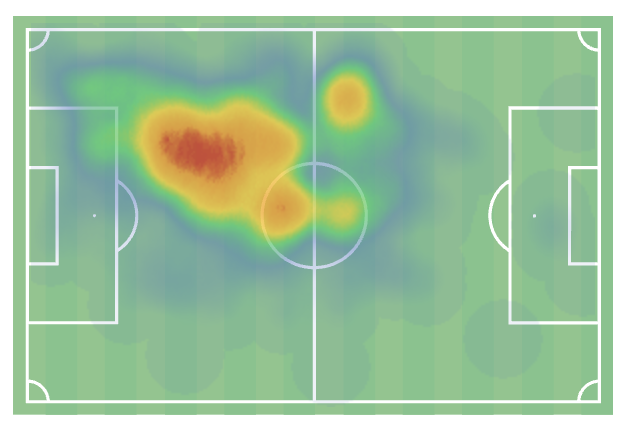
Here's Priso's heatmap from the 2026 season (all competitions), showing how aggressive he is on the ball as a centre back (WyScout)
In possession, Priso has averaged 68.31 passes per 90 (at a 94.4% clip), including 3.24 long balls (at a 60.9% clip), 8.17 passes to the final third (at a 87.9% clip), and 21.27 forward passes (at a 87.4% clip). Then, defensively, he’s averaging 4.23 interceptions, 12.11 recoveries, 10.28 duels (with a 56.2% win rate), 2.11 aerial duels (at a 46.7% win rate) 4.79 defensive duels (with a 70.6% win rate).
If he continues on this pace going forward, his 2026 numbers are right in the range of what Blackmon averaged, and are even better in some categories, such as passes attempted and recoveries.
What that all shows, though, is why Priso earned a call-up to the CanMNT. Clearly, as the numbers revealed, he’s been a pretty good fit at the centre back position, and that will have caught the eye of Canadian head coach Jesse Marsch, who likes his centre backs to defend the way Priso has - aggressively and on the front foot. 
While he was whistled for a foul here, this is the sort of aggressive centre back play that Jesse Marsch loves to see from CanMNT defenders (OneSoccer)
That’s why Marsch called up Priso to his January Camp squad (where Priso impressed in a friendly against Guatemala), and why he’s now called him up for this March window.
“It’s great that this is a big opportunity for Ralph,” Marsch said of Priso. “He did well in the January camp and game, specifically. We all looked at him as a midfielder before, and now, out of necessity, Vancouver shifted him into the backline, and he may have found a really good home for himself.”
While he might not have the size of other Canadian centre-backs, such as the hulking Moïse Bombito and Alfie Jones, that won’t bother Marsch, who has given opportunities to other smaller centre-backs, such as Luc De Fougerolles, based on the aggression that Priso himself has shown.
“What I like about Ralph is that he has an ease to him and a natural fearlessness,” Marsch continued. “No matter how you use him, he winds up inserting himself in the game and being a positive. Will we start him in one of the matches? I'm not sure yet.”
“Let's see how the camp goes and what he looks like, but I think he's a candidate to start a match. And I think that he's elevated himself by how he played in January with us and the kind of start to the season he's had with Vancouver.”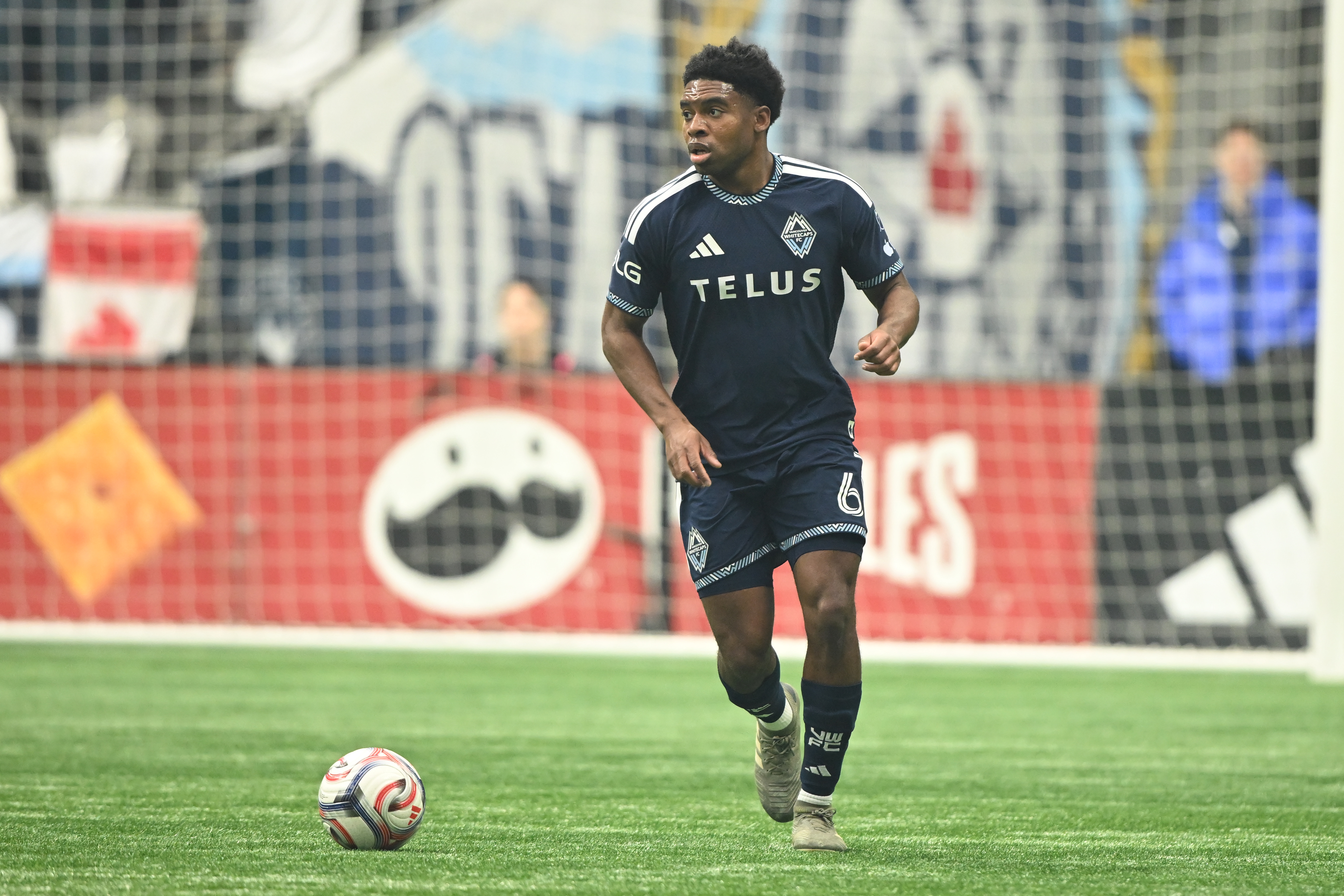
To that last point, though, it’ll now be fascinating to see if Priso ends up featuring in this window, especially after seeing Marsch suggest that it could be a possibility.
What it shows, though, is that this call-up isn’t just a courtesy call to respect Priso’s form - Marsch clearly sees Priso as a potential option at centre back, especially considering the injury crisis Canada has had at the position over the last few months.
Heading into the World Cup, Marsch knows that he may need to rely upon centre backs not named Bombito, Jones, De Fougerolles and Derek Cornelius, who are his top four centre backs when healthy, with Bombito and Cornelius the preferred pairing.
As seen in 2025, where De Fougerolles, Jones, Joel Waterman and Kamal Miller all featured, among others, Marsch might have to use some surprising faces at the position at the World Cup, and he’s still figuring out his best options to turn to.
What that shows, though, is why there’s such a big race brewing between Priso, Waterman and Miller, who all appear to be battling to earn the fifth centre back spot on this World Cup squad (there’s a world where two or even all three of them go to the tournament, but only if the main four names suffer injuries).
At the moment, Waterman is the leader, as he played significant minutes for Canada last year (almost 600’), and fits the system quite well. Plus, a move to the Chicago Fire has put him in a much better position than where he was with his old club, CF Montréal, as he’s been a good fit in Gregg Berhalter’s ball-playing system with the Fire.
When looking at the numbers, you can see why Waterman’s the early leader - when comparing Waterman and Miller’s 2025 numbers to Priso’s numbers over the last six months, Waterman has some standout figures.
For example, on the ball, while Priso edges the other two in terms of pure passing volume, Waterman has the best long ball, passes to the final third and forward passes numbers volume-wise - although Priso does get the ball to the final third at the most consistent rate, percentage-wise. 
Then, defensively, Waterman has the most interceptions, recoveries, and duels won, although Priso wins the highest percentage of his duels. 
Of course, that doesn’t tell the whole story - with Waterman and Miller’s presence on teams that barely made the playoffs in 2025, that did help them accumulate more defensive volume.
Yet, much like above, that Priso’s numbers are comparable is a good sign for him, given his adaptation to a new position - especially when you remember that his numbers have hit a new level in 2026, with this comparison using his figures from both 2025 and 2026 combined. For context, here’s how his 2026 numbers stack up.
As seen here, Priso's 2026 numbers stack up quite nicely compared to his CanMNT peers, especially in terms of passes to the final third, forward passes, interceptions and recoveries (WyScout)
Now, it’s worth noting that any of these numbers won’t really matter for Marsch, who will be looking at how these three fit into his team, which is where Priso will want to really make the most of his audition this window.
For example, to show how well he can fit in Marsch’s system, look for Priso to use his footspeed to his advantage, allowing him to play extremely aggressively. Canada doesn’t have a whole lot of footspeed beyond Bombito and De Fougerolles, so that could be an area where he stands out. 
These are the sort of plays Priso will want to bring to the CanMNT - for a Canadian team that loves to play in transition, they like their centre backs to turn defence into offence (OneSoccer)
Then, his ability to play with the ball, especially as a left-footed player, could be a huge asset. With Bombito, De Fougerolles, Jones, and Waterman all sitting as right-footed players, Priso’s ability to use his left foot could help him, especially when considering that Canada’s main left-footed option, Derek Cornelius, doesn’t look likely to get a whole lot of minutes between now and the World Cup with his strange club situation at Rangers, which will affect his fitness at the World Cup. 
And here's another example of Priso turning defence into offence, before stepping into the attack to almost create a dangerous chance (OneSoccer)
Sometimes, when it comes to a battle between multiple players, those can be the sort of things that could give someone an edge, and Priso will want to take advantage of that. 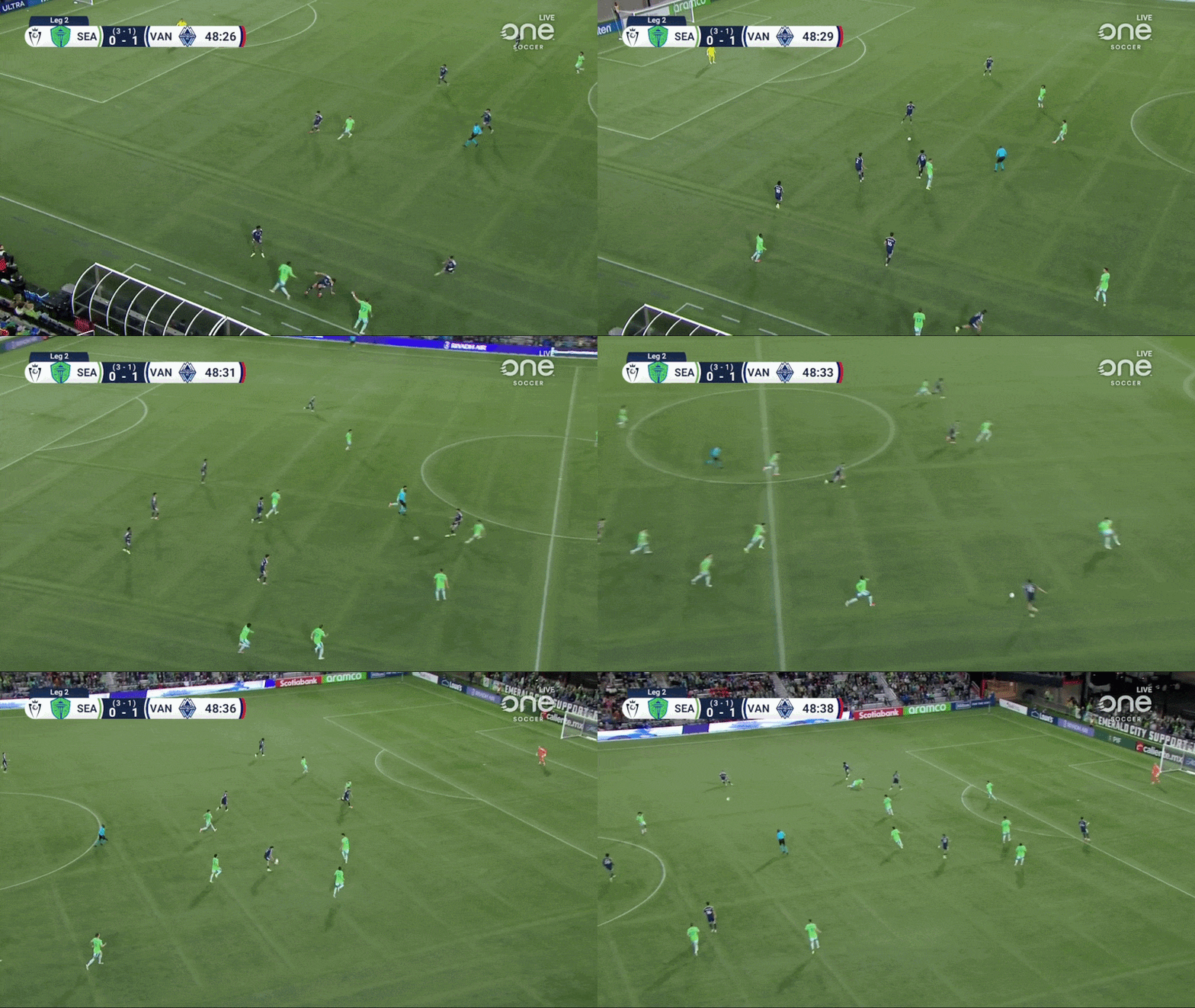
Here's one last example of Priso turning defence into offence, jumpstarting a dangerous transition moment thanks to a great progressive pass (OneSoccer)
Overall, though, what this all shows is that Priso is well-deserving of this opportunity and is certainly in the mix to make the World Cup squad.
While he’ll need to keep improving as a centre back to be considered one of the best in MLS and be included in the Canadian squad at the World Cup (and going forward), these numbers feel very encouraging when you remember how little time he’s had to work at this position.
Considering that he’s been seemingly getting better with every game he plays for the Whitecaps (as seen by the uptick in his 2026 numbers!), there are more improvements to come, too, giving him a higher margin of growth at the position.
Plus, there’s a reason why centre-backs tend to develop a little slower than other players, and why some players can be thrust into it later in their careers, like Priso, Bombito, Cornelius, Jones, De Fougerolles, Waterman and Miller all did (which is an interesting parallel), as it can be a position with a steep learning curve.
That’s why it’s been so encouraging to see Priso pick up the position the way he has, so he’ll now hope to keep this positive momentum going into this Canadian camp and beyond.
“I'm doing well. This is probably the most consistent I've ever been playing, so it's been good to be able to build a rhythm and know what to expect going into games, so that’s been a help,” Priso said this week, before his call-up became official. “The national team is always an objective for any player, so whatever I need to do at the club level to get that call, I'm going to try to do, and then it's up to the staff to make their decisions.”
All statistics via WyScout