Niko Sigur joins Toulouse FC - where can versatile breakout CanMNT youngster fit in?


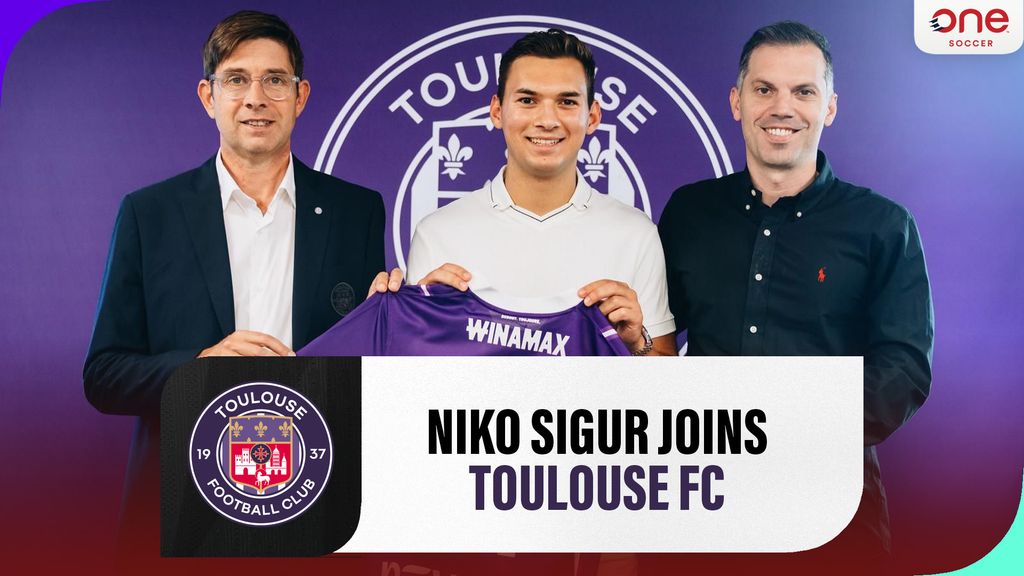
Niko Sigur is the latest CanMNT player to make a move to a club in the top five European leagues, as the 22-year-old joined Ligue 1 side Toulouse FC in a deadline-day move on Tuesday.
There, he’ll link up with fellow Canadian Jacen Russell-Rowe, who joined the French club from the Columbus Crew at the beginning of 2026.
Given that Russell-Rowe has carved out a decent role for himself with Toulouse since arriving, making 17 appearances and scoring two goals (including one last weekend), Sigur will hope to be able to find his feet just as quickly to start his time in France.
Based on Toulouse’s announcement video, Sigur should get every opportunity to earn a place in his new team’s starting lineup over the next few months, as they made sure to tout his versatility as a player as something to watch. With Sigur’s ability to play both as a full-back and central midfielder, that should hopefully allow him to find a role in his new team right away.
Polyvalence. Solidité. Précision 🔨🦺
— Toulouse FC (@ToulouseFC) September 1, 2026
Bienvenue Niko ! 😈 pic.twitter.com/IAuTrMSpU0
When looking at their squad, it appears that opportunity is more likely to come at full-back to start, as the club has a decent amount of central midfield depth, but not a lot of full-back depth.
Given that the club has switched from using a back three or back five last season to a back four this season, as new head coach Jens Berthel Askou has come in and switched their formation, there is room for Sigur to slot in rather rapidly, actually, as Toulouse has just three natural full-backs in their squad - by comparison, they’ve got seven central midfielders.
Because of that, keep an eye out for him to perhaps make a few appearances at that position to start - from there, it’ll be up to Toulouse to decide if that’s where his best position lies, or if they want to move him into midfield long-term.
Yet, that’s the most fascinating thing to watch with Sigur’s career going forward - figuring out what his position on the pitch truly is.
At this point, despite him playing a decent amount of both full-back and central midfield for both club and country, there isn’t a clear answer as to what that best position is, as he’s put in standout performances at both.
As a result, the answer at this stage is more about what his team needs from him, compared to what he can actually do in either position. Had there been any sort of dip in his performances in either position, you could make the argument that it’d be better off to switch, but that hasn’t been the case quite yet.
Plus, if you ask him, he truly seems not to mind playing in either position, which is rare to see, as players are usually quick to talk about where they prefer to play on the pitch, especially if they’re deployed in one that they’re unfamiliar with.
To that point, though, while there hasn’t appeared to be much difference between Sigur’s performances as both a full back and as a central midfielder by the eye test, what do the numbers say?
To find an answer, it’s worth taking a look at Sigur’s numbers as a midfielder for both club and country, and as a full back, seeing if there is any key difference between the different categories. Or, at the very least, whether there is one position where there are more standout numbers, as his solidity at both positions is likely to mean that the data is unlikely to expose any weaknesses or poor numbers.
When doing that, a few things stand out. 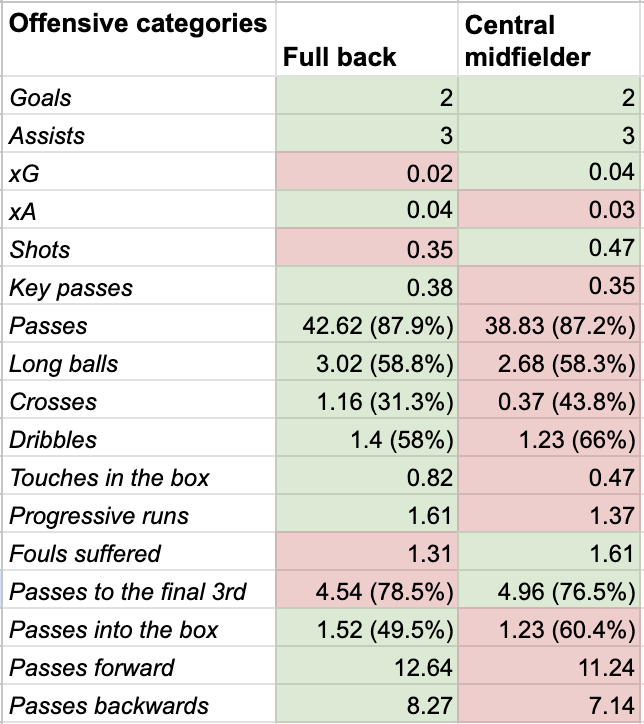
Here's how Sigur's offensive numbers compare between full back and central midfield (WyScout)
Firstly, on the ball, Sigur’s numbers are pretty similar at both positions, but it’s worth noting that he’s a bit more involved in possession when playing at full back, averaging more passes and long balls.
That’s interesting, although that’s hardly that surprising - in the modern game, full backs can often be asked to play a key role in helping their team in possession, especially when they have the profile someone like Sigur has, who is comfortable playing in midfield.
What’s more interesting to see, though, is that Sigur’s other attacking numbers are a lot better than one would expect from him at full back, including some of his final third numbers.
For example, Sigur generated more key passes, Expected Assists, touches in the box and passes into the box at full back than in midfield, as he’s only generated more shots and Expected Goals as a midfielder. Plus, he’s also averaging better progressive runs and dribbling numbers, further showing how comfortable he’s been in possession, as he’s playing a key role in progressing the ball up the pitch from that position.
Then, defensively, Sigur cleans up in every major category at full back, averaging better interceptions, recoveries, clearances, duels, defensive duels and aerial duels at the position. Granted, that’s not surprising to see - one would expect one to earn more defensive actions when playing as a defender than at another position, but it’s still a surprise to see a clean sweep, as one would’ve thought that he might’ve had better interception numbers in midfield, for example. 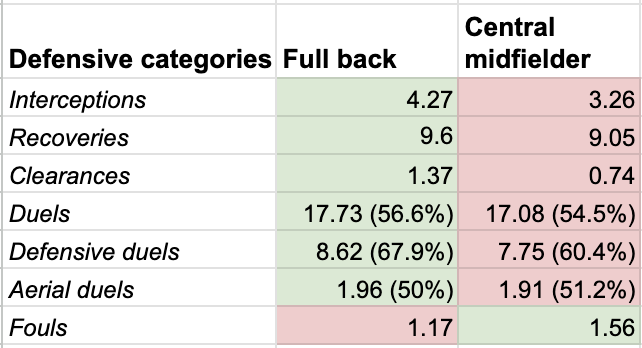
Here's how Sigur's defensive numbers compare between full back and central midfield (WyScout)
Yet, that shows why this data is actually quite surprising to look at. Perhaps you would’ve expected there to be a bit more of a split between both positions, but Sigur’s numbers appear to be better across the board as a full back.
It’s worth noting that there are some caveats with this data, as there always are with numbers - it’s important to remember that Sigur’s full-back numbers come from over 6500 minutes of data, while his midfield numbers come from just over 3500 minutes of data, so he’s had significantly more time at full back to rack up better numbers (even if they’re presented on a per 90 basis). 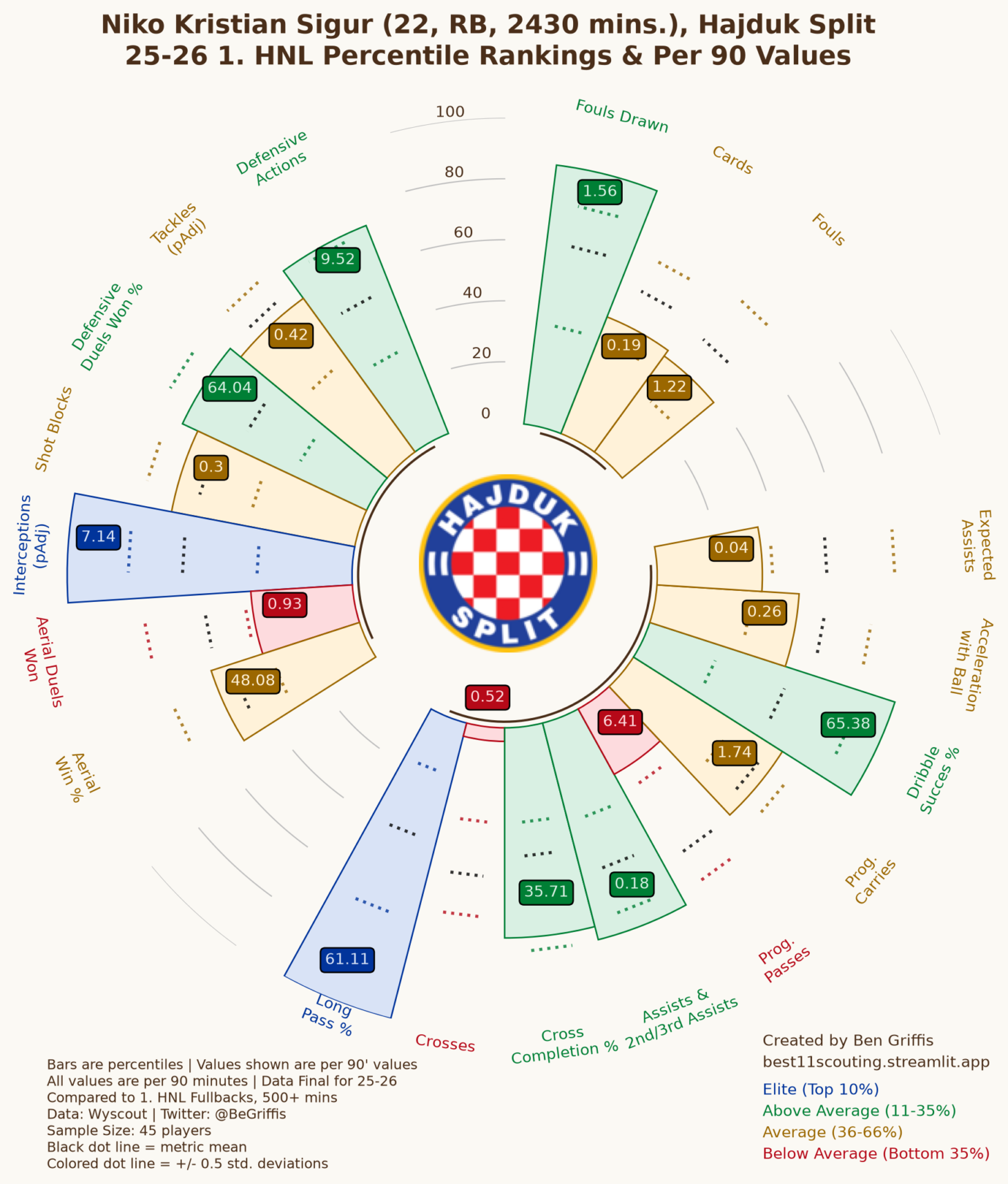
Here's how Sigur's numbers from his last full season in Croatia stack up - as a right back, he had some very good offensive and defensive numbers, unsurprisingly (WyScout)
Plus, it’s worth noting that when you look at the data, most of the numbers between both positions are quite similar - the only statistics where he’s averaging way better numbers at one position than the other are with his crosses, touches in the box and interceptions. At the end of the day, it can’t be forgotten that his numbers in midfield are actually very good, as he’s a very good option at the position for a reason.
At the same time, it’s quite reassuring to see how strong his numbers are as a full-back when considering what’s next for Sigur. With him likely to start at that position with Toulouse, it shows that he could be set to hit the ground running there, easing his transition to life at a club in a top-five European league.
Plus, from a Canadian perspective, it’s worth noting that it’s not the worst thing if Sigur ends up playing more as a full-back than as a midfielder going forward.
GOAL 🇨🇦
— OneSoccer (@onesoccer) June 18, 2025
NIKO SIGUR SCORES HIS FIRST FOR THE #CANMNT 😎
Canada go up 1-0 over Honduras with a smooth give-and-go, finished perfectly 💪
🔴 Watch Gold Cup on OneSoccer & TSN pic.twitter.com/ywuwiVMXEG
While it’s often felt like Sigur playing as a midfielder has been his most likely long-term career prospect, as it’s seen as a higher-ceiling position, Canada’s depth in central areas remains solid. Ismaël Koné is expected to return to an elite level when he recovers from the injury he sustained at the World Cup, while Nathan Saliba looks set to reach a new level after a recent move to La Liga outfit Villarreal CF.
And you can’t forget Stephen Eustáquio, who will remain a key piece of the CanMNT after a move to Swansea City, as well as Mathieu Choinière, who has been contributing at a good level for Los Angeles FC.
While adding Sigur to that mix just bolsters their depth at that position, that’s a lot of quality players fighting for what will likely be just two spots in Jesse Marsch’s midfield, unless he switches from his preferred 4-2-2-2 set-up to another formation that includes three midfielders to get more of his talented central options on the pitch at the same time.
At full-back, meanwhile, Canada’s depth is a little less certain going forward. Alistair Johnston looked set to remain a lock at right back going forward after an excellent World Cup, but he’s continued to be dogged by muscle injuries that could affect his long-term reliability, while Richie Laryea is now 31, so it remains to be seen how long he can stay in the picture this World Cup cycle.
There are some good youngsters in the Canadian pool, such as Jahkeele Marshall-Rutty, but given that Sigur has already accumulated an impressive amount of experience for Canada at the right-back position, that should give him the inside track over most options - Sigur was already competing for minutes with Johnston and Laryea last World Cup cycle for a reason, and that was before making a transfer like this.
GOAL 🇨🇦🇨🇦🇨🇦
— OneSoccer (@onesoccer) September 5, 2025
Niko Sigur STARTS and FINISHES the counter-attack with a BANGER 🚀
Those CanMNT starting XI locks are starting to look a little flimsy, no? 🔓
🔴 Watch LIVE on TSN & OneSoccer pic.twitter.com/iYecrI50Sx
Therefore, if he can do well with Toulouse as a full-back, he has a pretty good chance of becoming Canada’s regular right-back option going forward, whereas his chances of starting in midfield are a bit loftier (even if he did shine at the position for Canada in their World Cup knockout matches).
Plus, it’s not as if becoming a more regular full-back rules him out of playing in midfield for both club and country - after all, as mentioned before, there’s a reason why Toulouse touted Sigur’s versatility as an asset.
At the end of the day, he’ll be able to slot in wherever he’s needed to help his team, and do an excellent job, as the numbers show - it just happens that there’s an opportunity for him to become a regular at full-back for Toulouse and Canada in the short term, and based on those same numbers, that’s a pretty good outcome for all parties.