How can the CanMNT fix their slumping attack ahead of the World Cup?


Who will score the goals for the CanMNT this summer?
That’s the big question that many are asking as Canada gets set to kick off their World Cup journey against Bosnia & Herzegovina at Toronto Stadium on Friday.
Having only scored eight goals in their last nine games heading into the start of the tournament, it’s a massive concern for this Canadian side, who will know that they need to be more dangerous in front of goal if they’re to achieve some of their loftier World Cup objectives.
Given that some of Canada’s most impactful offensive players enter this tournament having also struggled to score in recent games with the National Team, it’s a huge worry, one they must solve quickly.
For example, look at Jonathan David, who is arguably Canada’s most important offensive player. The CanMNT’s all-time top scorer with 39 goals in 77 caps (along with 20 assists), David enters this World Cup having scored just twice in his last nine appearances for Canada - and both goals came from the penalty spot, in the same game.
In fact, in his last 15 appearances for Canada, David has scored just two non-penalty goals, with one coming against nine-man El Salvador at the 2025 Gold Cup last summer, and the other coming against Romania in a friendly last September.
You add in that he scored just eight goals in 46 appearances during a trying first season with Italian giants Juventus, and that’s all quite concerning to see, as David has struggled to show his best for both club and country as of late.
At the same time, when looking at just his performances for Canada, you can understand why he’s struggled to score when seeing that he’s been asked to play as more of a #10 instead of as a striker, with his role being to help create chances for his teammates. If him playing deeper meant that the rest of Canada’s attackers were firing on all cylinders around him, it could be argued that the trade-off of losing some of David’s productivity might be worth it.
No. 10 or No. 9? 🤔
— OneSoccer (@onesoccer) June 9, 2026
Is Jonathan David being utilized in the best way possible for the CanMNT 🇨🇦? 👀 pic.twitter.com/pboWXnN78j
Yet, when looking at Canada’s other attackers, their numbers are similarly worrying. Look at some of Canada’s projected starters for the Bosnia match, such as striker Cyle Larin, and wingers Tajon Buchanan and Liam Millar.
Heading into this tournament, Larin has scored just once in his last 24 appearances for Canada (coming against Panama in October of 2024), Millar hasn’t scored in his last 21 appearances for Canada (his last goal came against Cuba in the 2023 Gold Cup), while Buchanan hasn’t scored in his last 10 games for Canada (his last goal came against El Salvador at the 2025 Gold Cup).
At the same time, it’s not as if some of Canada’s other options off the bench have fared much better, either, as Tani Oluwaseyi has just two goals in his last 24 appearances for Canada and Jacob Shaffelburg hasn’t scored in his last 11 appearances for Canada.
Then, even when it comes to players who have had decent production, such as Promise David, who has scored three goals in just 238 minutes across 10 total appearances for Canada, and Ali Ahmed, who has one goal and four assists across his last 14 appearances for Canada, both enter the start of the tournament coming off injuries that will likely restrict their ability to start games right away.
All of that to say, that helps paint a picture of why many are worried about Canada’s attack. Not only have they struggled to score as a team, but many of their key offensive players enter this tournament either out of form or coming off injuries, and Canada's head coach, Jesse Marsch, hasn't experimented with his attack all that much in search of potential solutions.
Given that so many of Canada’s attackers are struggling, however, it poses the question: why is that the case? Had only a few of them been doing poorly in front of goal, you could suggest that the problem is more of an individual one, but when everyone is slumping, including your main offensive threat in Jonathan David, it paints the picture of a bigger problem. 
Because of that, it’s worth pulling back the hood to see if any specific numbers stand out from Canada’s recent stretch of games. By doing that, you can see if there are bigger worries, or if Canada is perhaps unlucky - it’s not abnormal in the sport for teams to have extended runs of bad luck across a sample size like this.
Unfortunately for Canada, that’s not an issue that they’re dealing with. When looking across their last 10 games, a span across which they’ve scored 11 goals, they’re generating… 11.07 expected goals (xG). Which means that they’re performing almost exactly as one would expect them to do statistically. 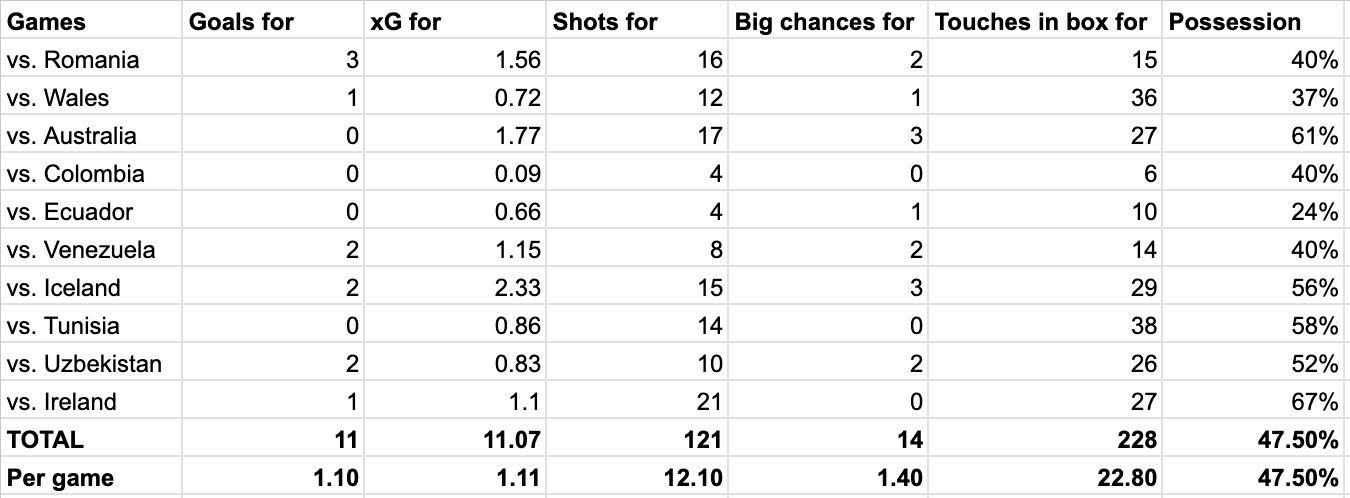
Here are the offensive statistics from Canada's last 10 games (OPTA)
Granted, there is a game that inflates those stats a bit, as you’ll notice that the sample is across 10 games, while earlier in the article it was mentioned that Canada had scored just eight goals in their last nine games. For this chart, their friendly against which they scored three times in a 3-0 win vs. Romania was included, even if that’s arguably the last game they had before the slump started, as that game actually provides an early red flag about Canada’s oncoming struggles.
Even though they scored three times on that day, they did so despite generating 1.56 xG from 16 shots (0.09 xG per shot), as they didn’t actually take a lot of quality shots on the day. Seeing that they also only created two big chances and took just 15 touches in Romania’s box further backs up that sentiment.
That’s not to say that Romania win was a bad performance - in fact, it was an excellent one, arguably one of Canada’s best under Marsch - but considering that two of their three goals came from a set-piece and a horrible Romanian giveaway, it’s not as if it was a free-flowing, sparkling offensive performance (even if their third goal, which Niko Sigur scored with a beautiful finish, did come after some excellent combination play).
When looking at the rest of that 10-game sample, the data from that Romania game ends up fitting in surprisingly well with the rest of the numbers, as Canada has averaged 1.11 xG, 12.10 shots, 1.4 big chances and 22.8 touches in the box per game across that span.
That’s a worry because there is nothing among those numbers, other than touches in the box, that suggests Canada could be due for their luck to swing without changing anything.
Funnily enough, however, it feels like the touches in the box numbers fittingly help tell the story of Canada’s struggles. When looking back at Canada’s performances across these 10 games, they’ve typically done a good job of getting the ball to dangerous areas, but they’ve often struggled to generate high-quality chances.
The numbers back that up, as Canada is averaging just 0.09 xG per shot across their past 10 games, and that’s despite there being two penalties in this data set (which are typically worth around 0.74 xG), which actually makes these numbers look even better than they are.
Considering that Canada is holding more and more of the ball - they held more than 50% of possession in five of those 10 games, and four of those have been in the games they’ve played in 2026 - it further shows that Canada’s issue has truly been their shot quality.
That’s worth noting, as that feels fixable among potential issues. Considering that Canada has averaged 30 touches in the box per game in their last four games, they’re doing a better job of getting the ball to the areas of the pitch that will help them score more goals lately, showing that they’re at least trying to fix their offensive woes with tangible solutions.
So if that’s the case… how can they start scoring goals more regularly?
That’s where it’s interesting to dive into some of the film from Canada’s most recent game, a 1-1 draw against the Republic of Ireland in Montréal, to help pinpoint some of their issues.
Considering that the statistics for that game fall perfectly in line with Canada’s woes - they generated 1.1 xG from 21 shots (0.05 xG per shot), including zero big chances, despite taking 27 touches of the box and holding 67% of possession against Ireland - the film from that game should be fascinating to watch.
To start, there’s this clip from the 6th minute. There, Tajon Buchanan receives the ball out wide and eventually whips in a dangerous cross, one that gets cleared for a corner. Nothing wrong with that, right? 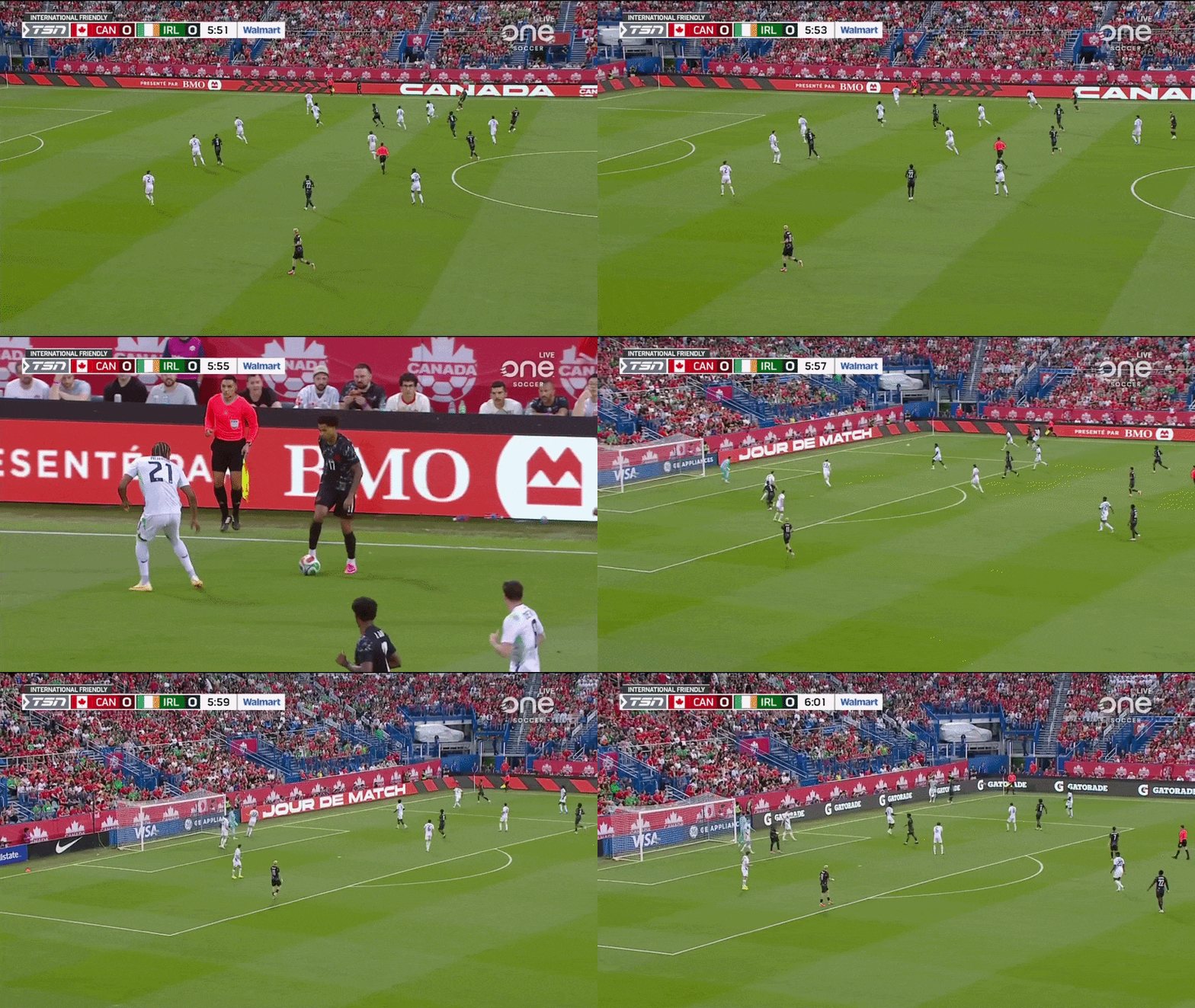
Well, while the outcome ended up being pretty decent, it stands out that at the time that the ball was cleared, there was one Canadian shirt in the box, striker Cyle Larin, and Larin was always going to struggle to get to this ball. 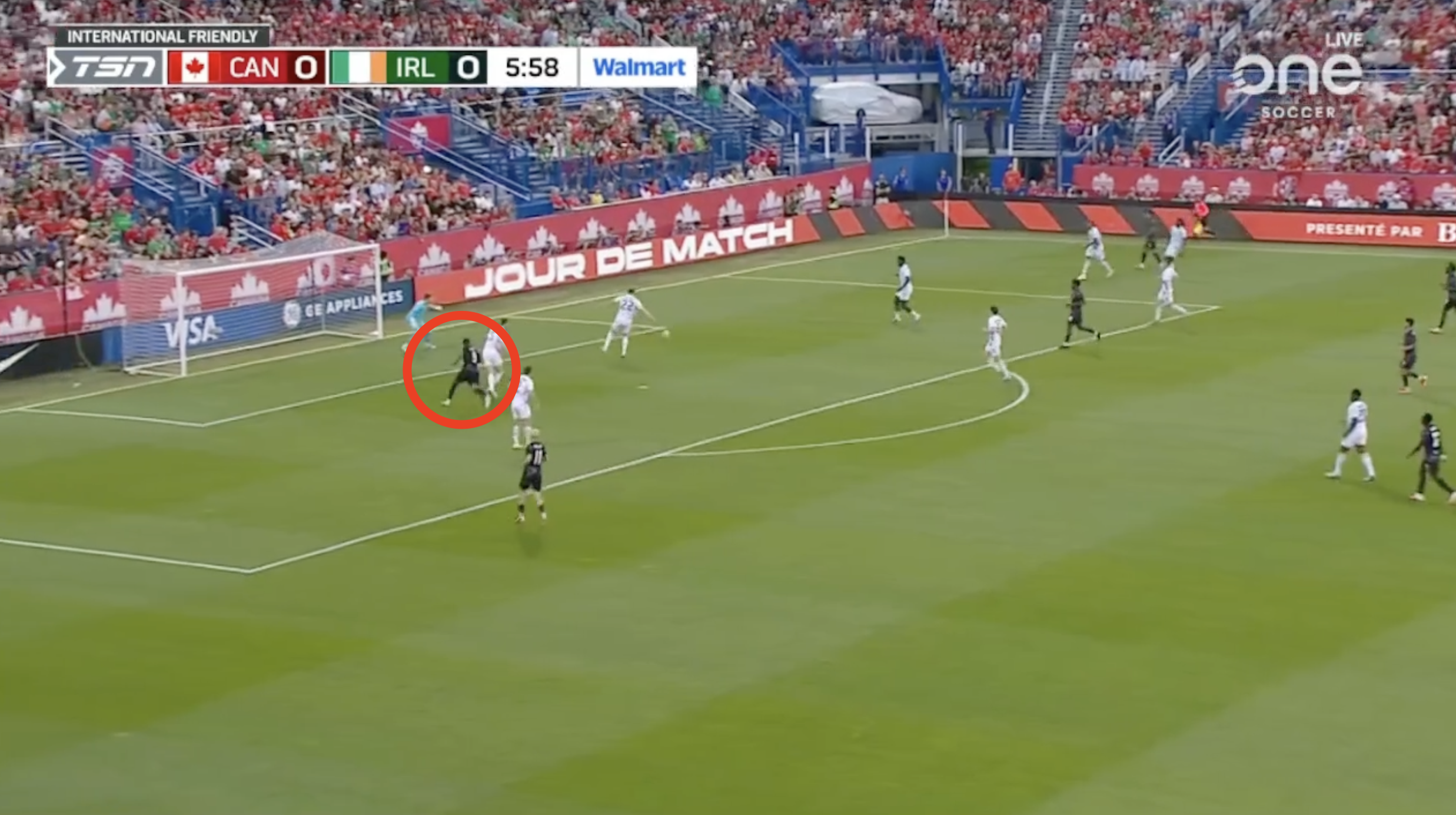
Immediately, that’s something to flag, as ideally, if someone is going to whip in a cross, you’d ideally like to have multiple players running into the box to increase your odds of getting someone on the end of it. When defenders only have to track one runner, it makes it a lot easier for them to focus on the ball and get to it first.
Moving on, there’s this clip in the 8th minute, which, once again, isn’t a bad sequence. There, Liam Millar does well to run into the box, cutting inside before firing a dangerous shot. 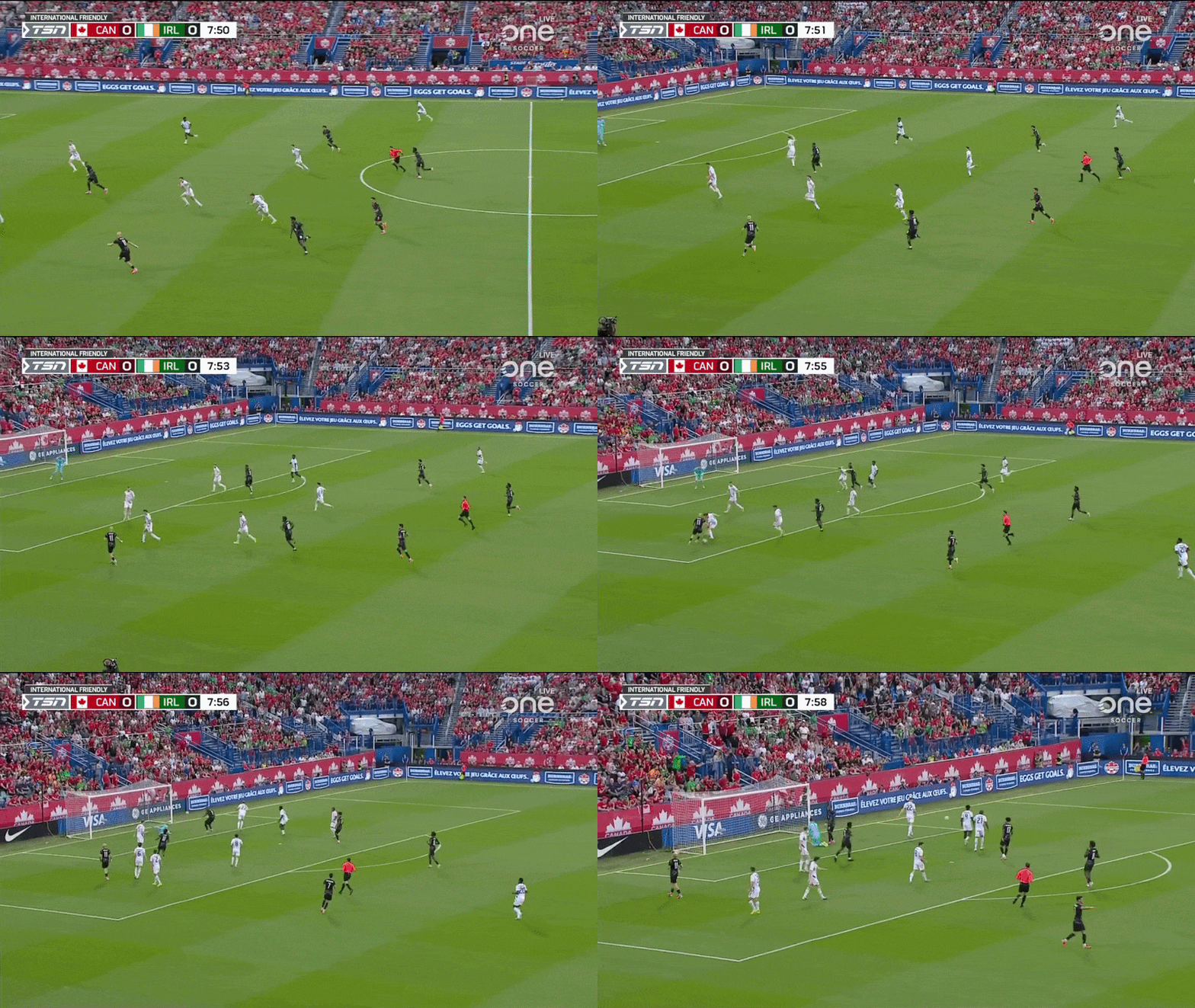
Nothing wrong with that, as Millar did well to generate a shot - the only thing is that considering that Larin was making a great run at the back post, and that Jonathan David had made a bursting run into the box, Millar will have needed to hit the target after ignoring both of those runs. 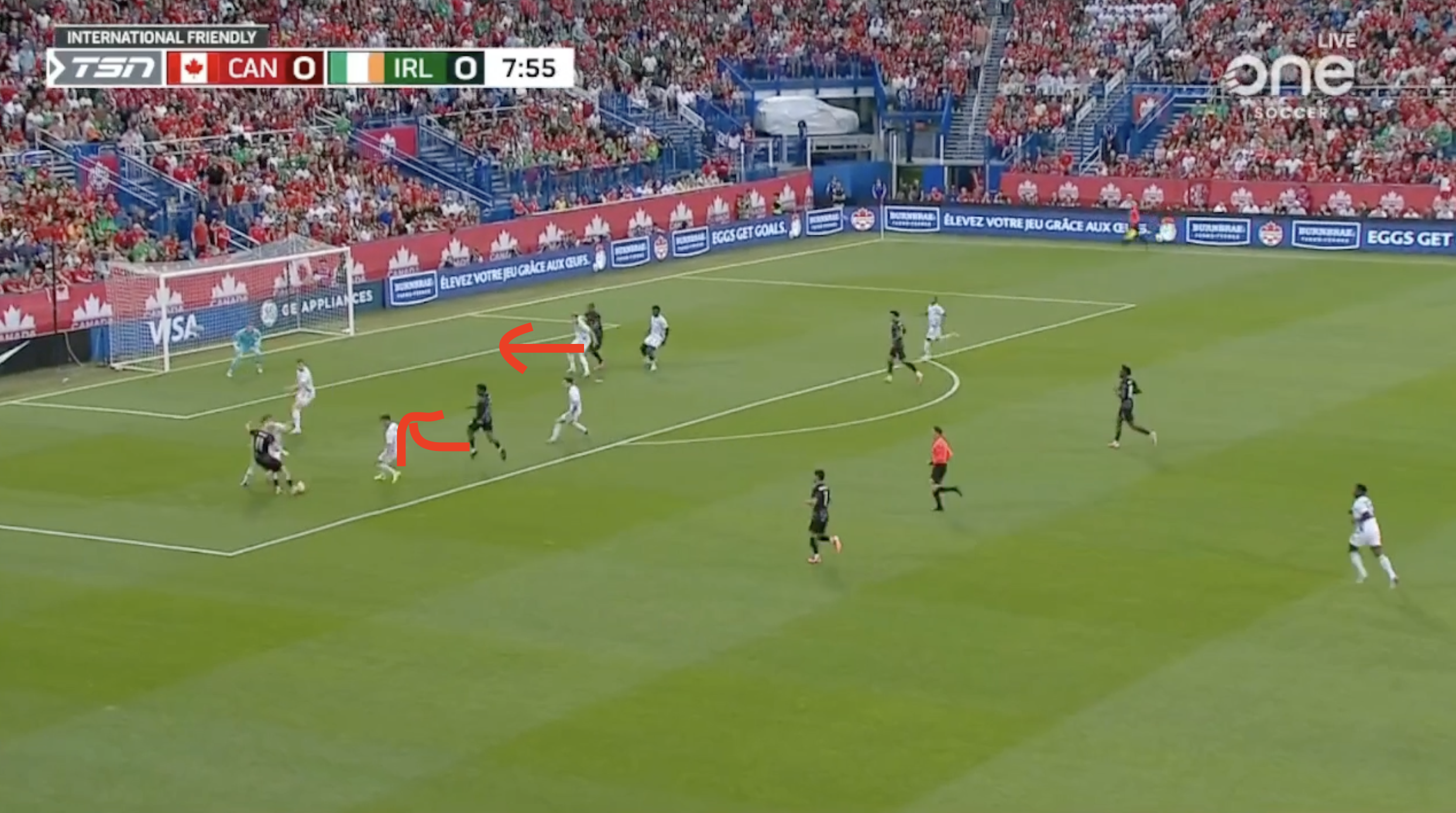
Next, there was this play in the 15th minute. On this play, nothing of note happens - what’s more interesting is what doesn’t happen. 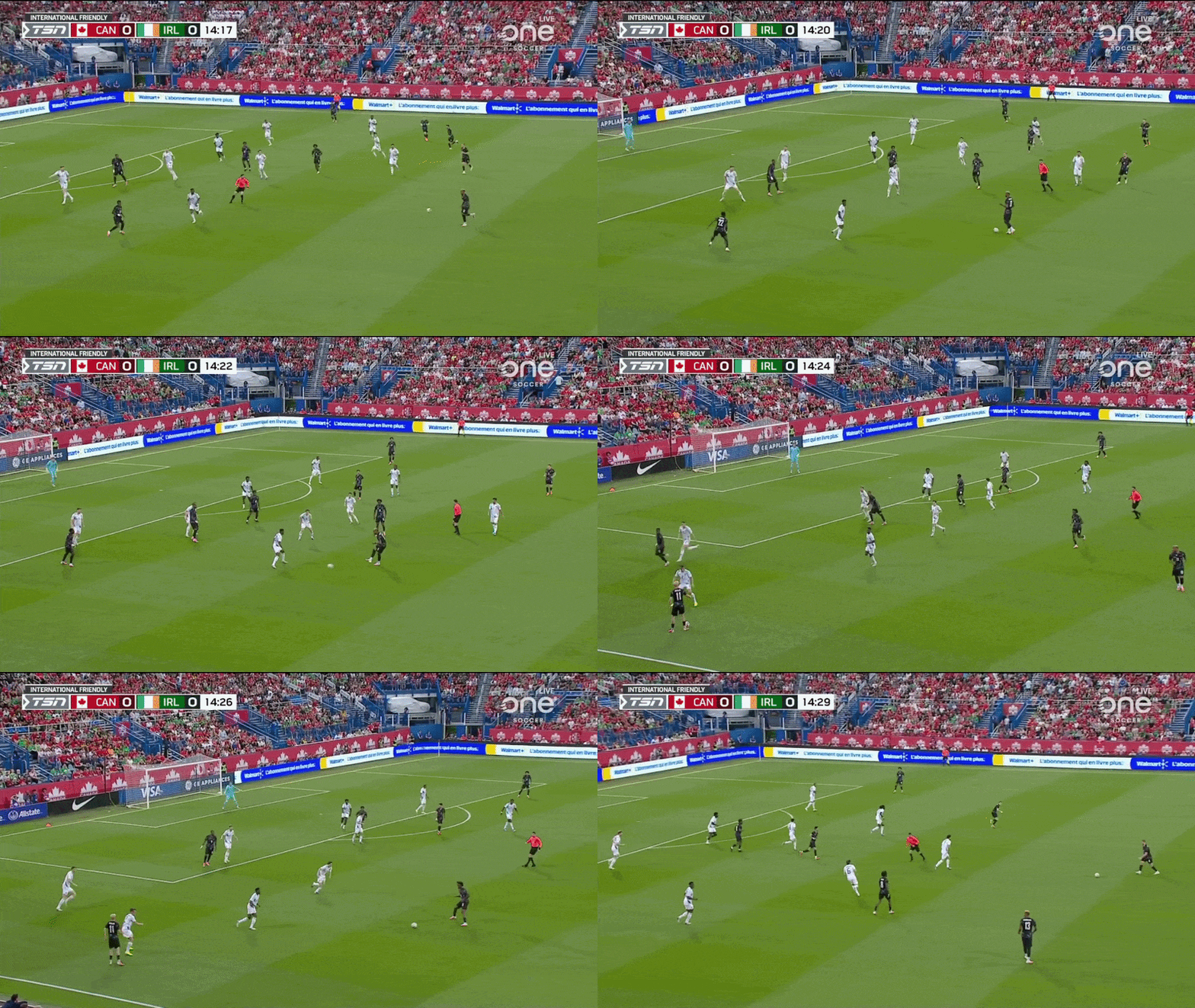
With Derek Cornelius on the ball, he looks up to play a line-splitting pass and notices that both of his strikers, David and Larin, are both flat-footed, and are occupying a similar space. As a result, he has to play a sideways pass to Millar, who encounters the same problem. 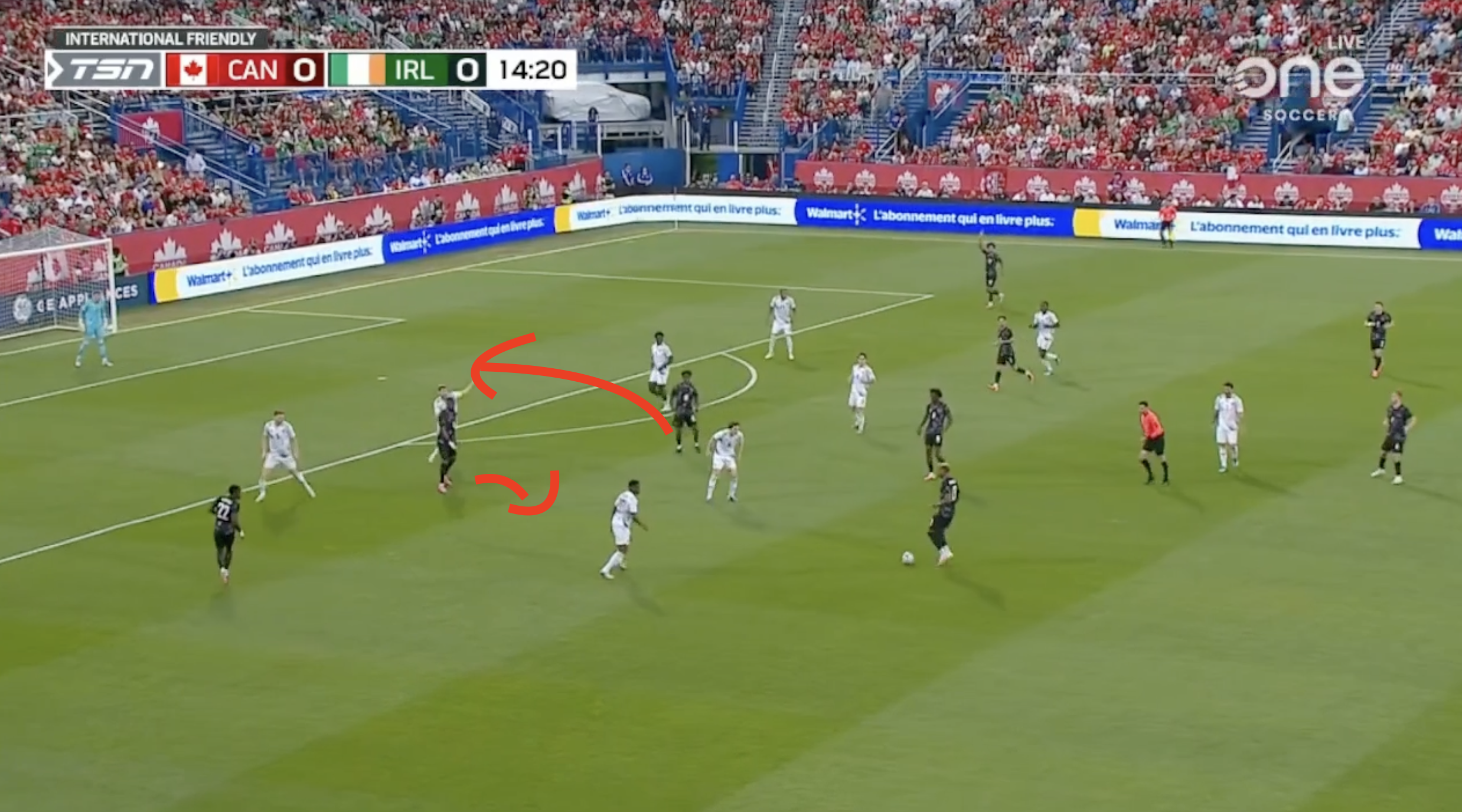
Given that Canada plays a two-striker system, ideally, one of their two strikers would drop in to receive the ball, while the other would make a run in behind to try and stretch the defence. Instead, they’re too static, which makes it easier for Ireland to keep them in front of their defensive line, which helps them keep that line flat and compact.
Moving on to the 30th minute, there’s another example of what that looks like. There, David and Larin end up in a similar area, when one of them should’ve perhaps made a run in behind the defence or towards the back post to open up space for the other - a big reason why the pair have struggled when paired together is that they often find themselves occupying similar spaces to each other like this. 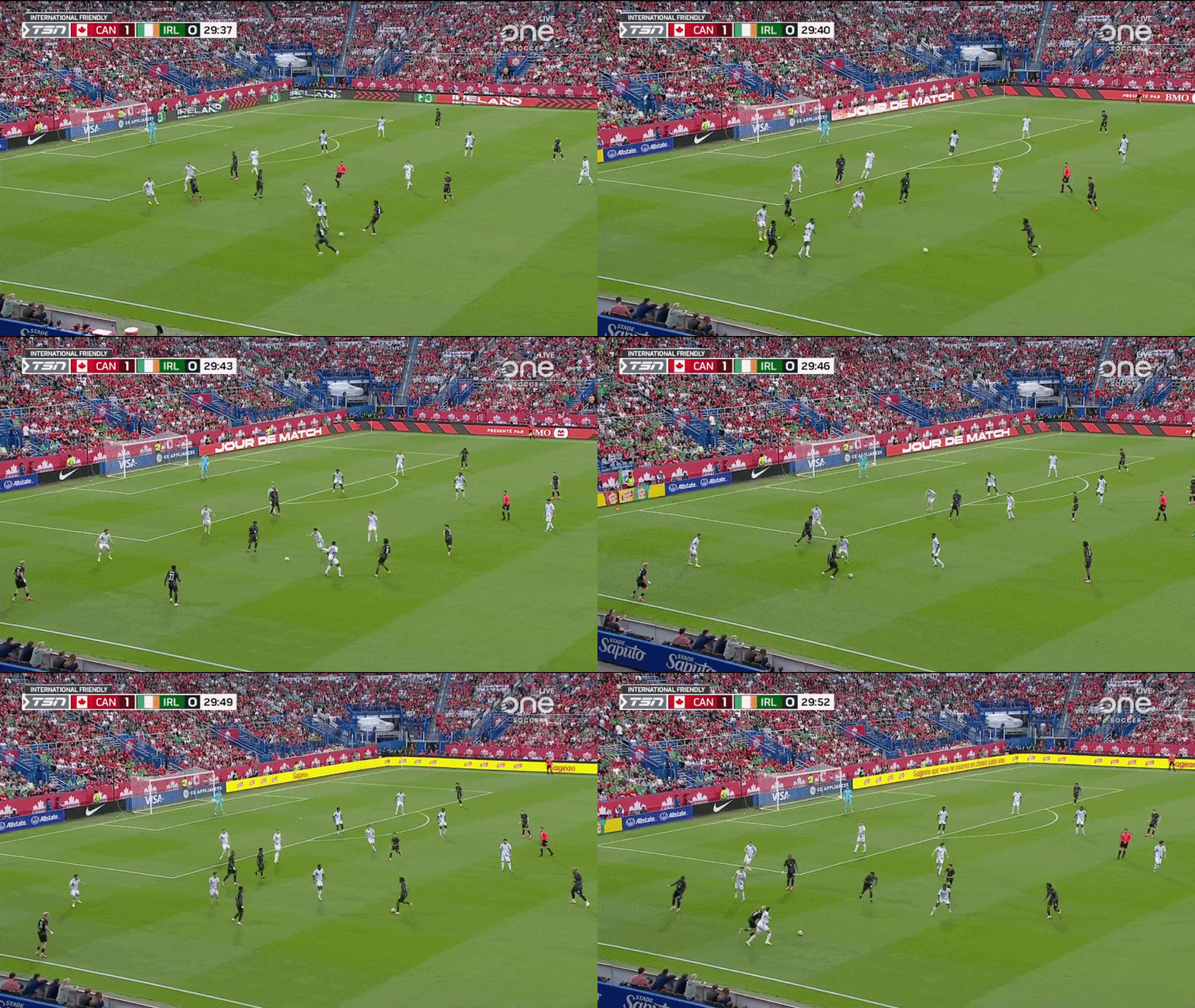
Overall, though, those clips help give an idea of where this Canadian attack has struggled - their final-third movement, and some of the decisions they’ve made on crosses.
At the same time, while it’s easy to look at both problems and suggest the movement is more fixable, it’s become a bit of a chicken-and-egg situation for this team.
For example, look at this moment in the 45th minute, which shows what that means. 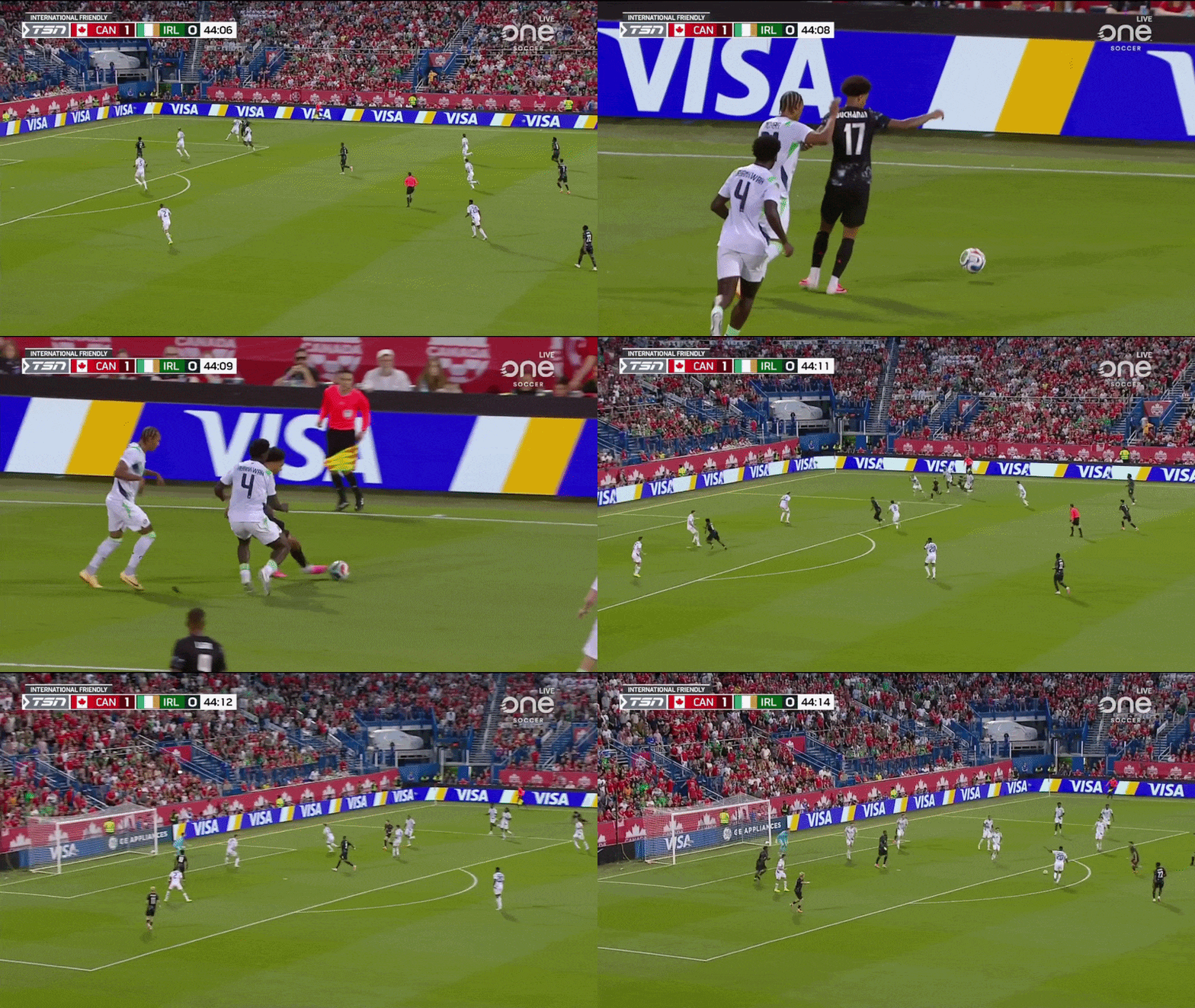
Here, Alistair Johnston makes a great run into the box, which Larin and David do well to anticipate. As a result, they do well to make the exact sort of runs you’d want two strikers in their position to make, with David peeling to the back post and Larin dropping into space for a near post cutback.
Despite that, Johnston fires a shot towards goal instead of trying to find them, much to their frustration.
And there are a few other examples of sequences similar to that one from this Ireland game. How about this 19th-minute sequence, one where Buchanan does an excellent job of running onto a fantastic Ismaël Koné pass. 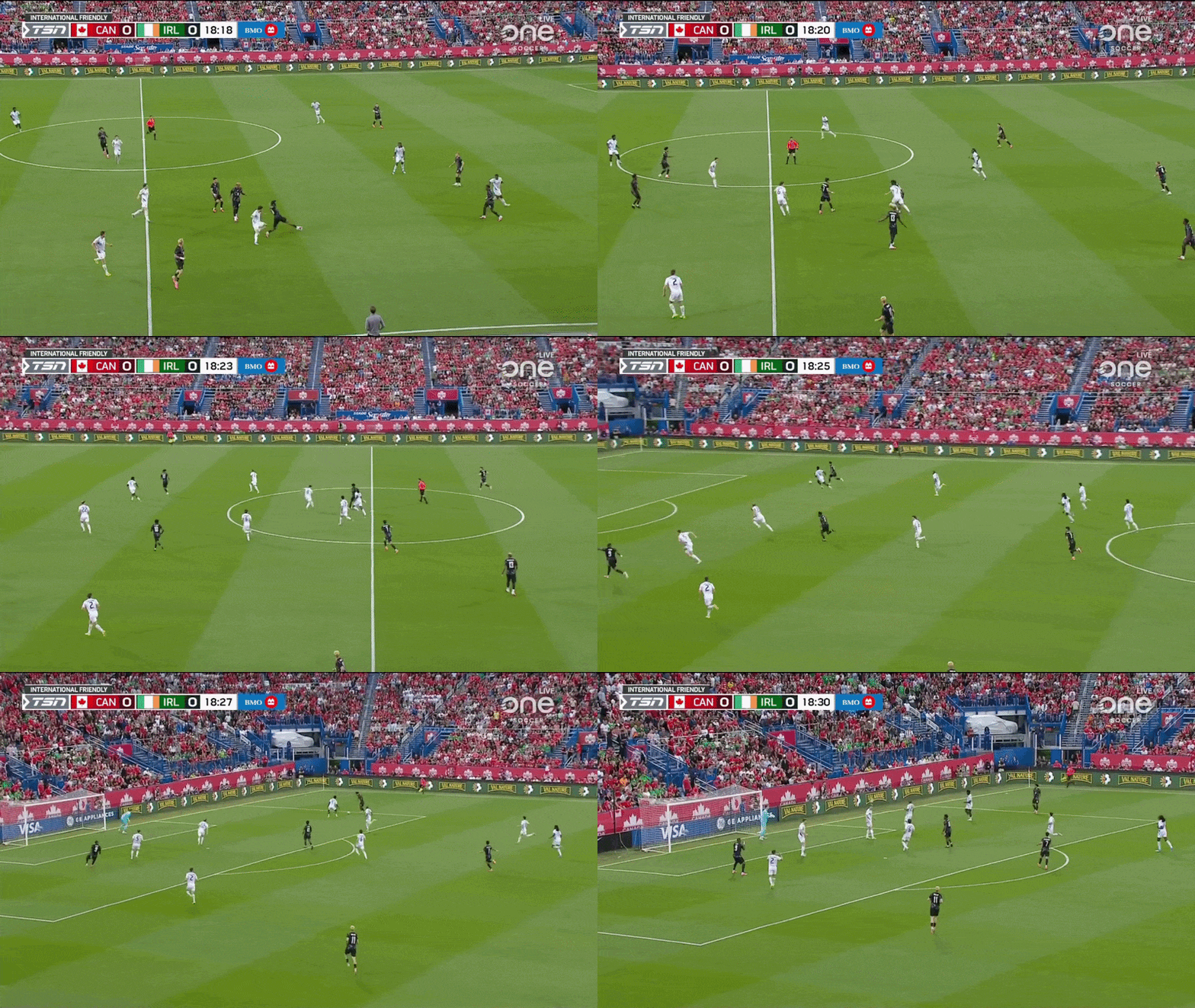
There, instead of spotting a textbook backpost run from Larin, Buchanan chooses to wait, and by the time he actually delivers the ball, the moment to cross is gone. He delivers that early ball and it’s arguably a goal, but instead, the moment went to waste because of indecision.
Yet, that speaks to the issue that Canada’s attack faces, which is that they’re not fully in sync - whether that's due to the system they play, how the players fit together, or other reasons. As seen throughout those clips, there are a lot of moments where they get to good areas, but then make the wrong action, whether that’s the player on the ball or the ones around them making runs.
Either they get plagued by indecision, as this next clip is a prime example of. Or, they actually make a great play, one filled with the right runs and passes, only to make an error on the final action, as they do here.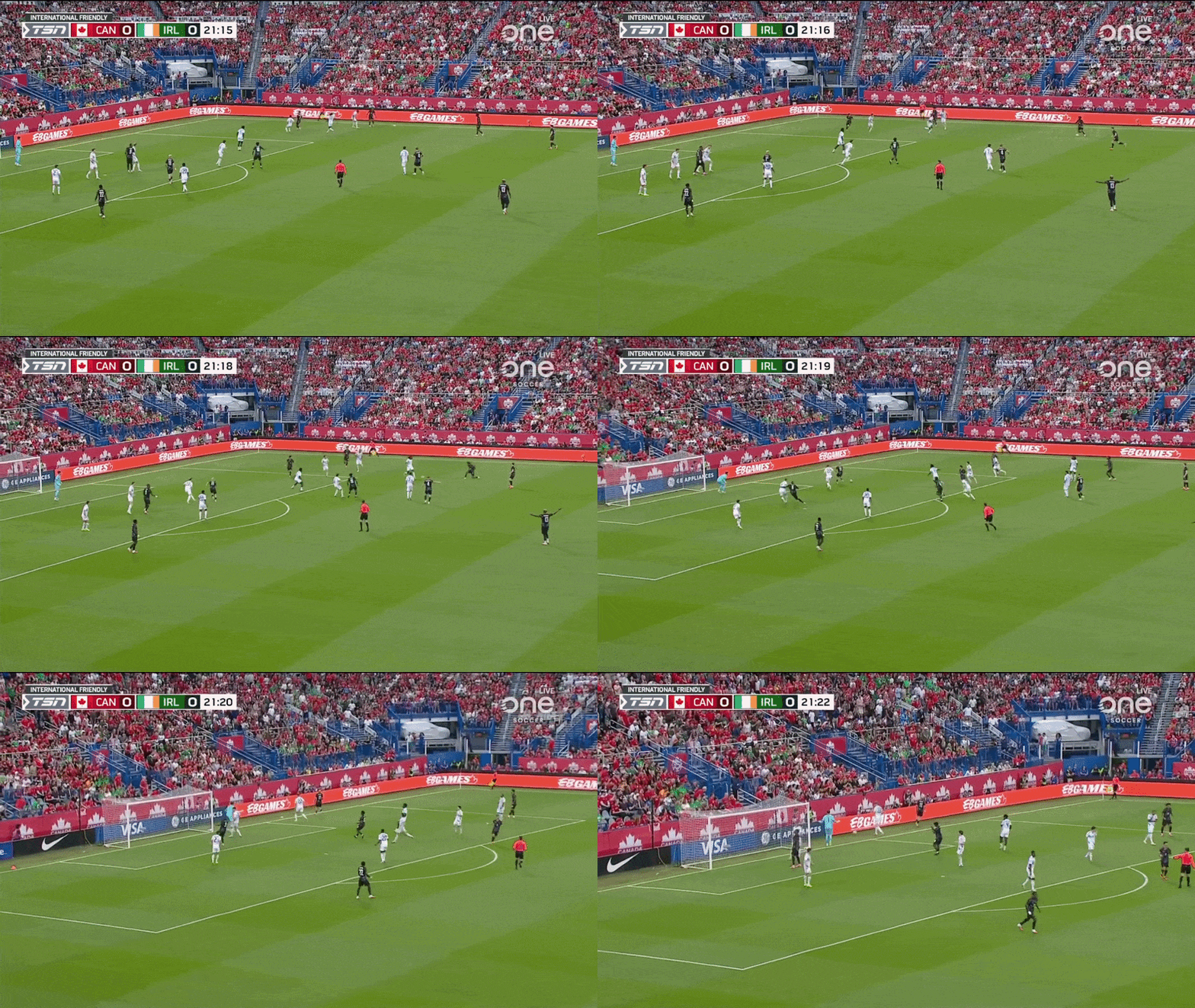
Now, how does one fix that? That’s the million-dollar question.
Clearly, as seen by these clips and in the numbers from earlier, it appears that Canada’s big problem in attack, to boil it down to a simple term, is their final action - whether that’s a cross or their decisions to shoot. They could be sharper with their movement at times, yes, but given that there are also examples of clips where they had good movement but were let down by final actions, you can also understand why they might be hesitant to make certain runs.
As a sidenote, that’s why a chicken-and-egg problem was referenced earlier, as it’s hard to say if moments where the movement is poor is because of the service, or if the moments where the service is poor are because of the movement.
Because of that, they need to find a way to get in sync with their final actions. Good attacking teams know how to come alive in the final third, so Canada will need to figure out a way to get all of their players on the same page with their runs, crosses, and other final actions (and determine whether this current set-up helps them do that).
Then, from there, the last thing will come down to execution. For example, Oluwaseyi is a prime example of that - while he didn’t feature in any clips here, the statistics show that he’s been one of Canada’s most dangerous strikers, and a big reason for that is his excellent, consistent movement.
Where he’s struggled, however, is with putting away the chances that he gets on the end of, as his finishing has let him down on a few occasions.
So for Canada, it shows that their mission will be twofold when it comes to scoring more goals this World Cup. They’ll need to be much sharper with their final actions to create more high-quality chances for all of their attackers, especially David, and then, when those chances come to them, they need to be a lot more dangerous and ruthless in finishing them.
It sounds so simple to say, but a lot harder in practice - that’s why goalscoring is often one of the hardest things to do consistently in this sport, after all.
For what it’s worth, it’s encouraging that Canada are getting into the box more, which is half the battle - had they not been doing that, this article would be a lot more pessimistic and suggest they blow things up completely. Some more tactical experimentation could help their cause, no doubt, but it's not as if they're wildly off-track compared to where they want to be.
Now, though, they’ll shift their focus towards tightening up those final actions, knowing that doing so could be the difference between an early exit and a run into the knockout stages.
All numbers via OPTA, all clips via OneSoccer/TSN.